Identity, enrollment & access

The agency decides who gets in — and what happens after they do.

MuniMessage separates government verification from organization enrollment. A verified domain can establish trust, while agency policy determines which individual users may create accounts, where they belong, and what they can access.

MuniMessage identity and access controls
Choose an enrollment model

From simple self-service to tightly restricted access.

Each organization can decide how much control is required before a new user is admitted.

Open domain

Verified domain self-enrollment

Allow any user with an email address on an approved agency domain to verify that address and create a MuniMessage account directly from the login page.

  • Lowest onboarding friction
  • Still requires control of the government mailbox
  • Agency roles and boundaries apply after enrollment
Controlled

Invitation-only enrollment

Keep the domain recognized but require an administrator or designated manager to invite each person before account creation is allowed.

  • Useful for limited rollouts
  • Prevents broad employee self-registration
  • Supports deliberate department-by-department adoption
Restricted

Approved users or groups

Restrict enrollment to selected people or departments. Enterprise identity integration also supports admission based on approved directory groups.

  • Supports specialized teams
  • Works with tighter organizational boundaries
  • Can align access with connected identity systems
Enrollment policy is an administrative control. Agencies can change the model as deployment expands — for example, starting invitation-only and later enabling self-enrollment for an approved domain.
Guardrails after enrollment

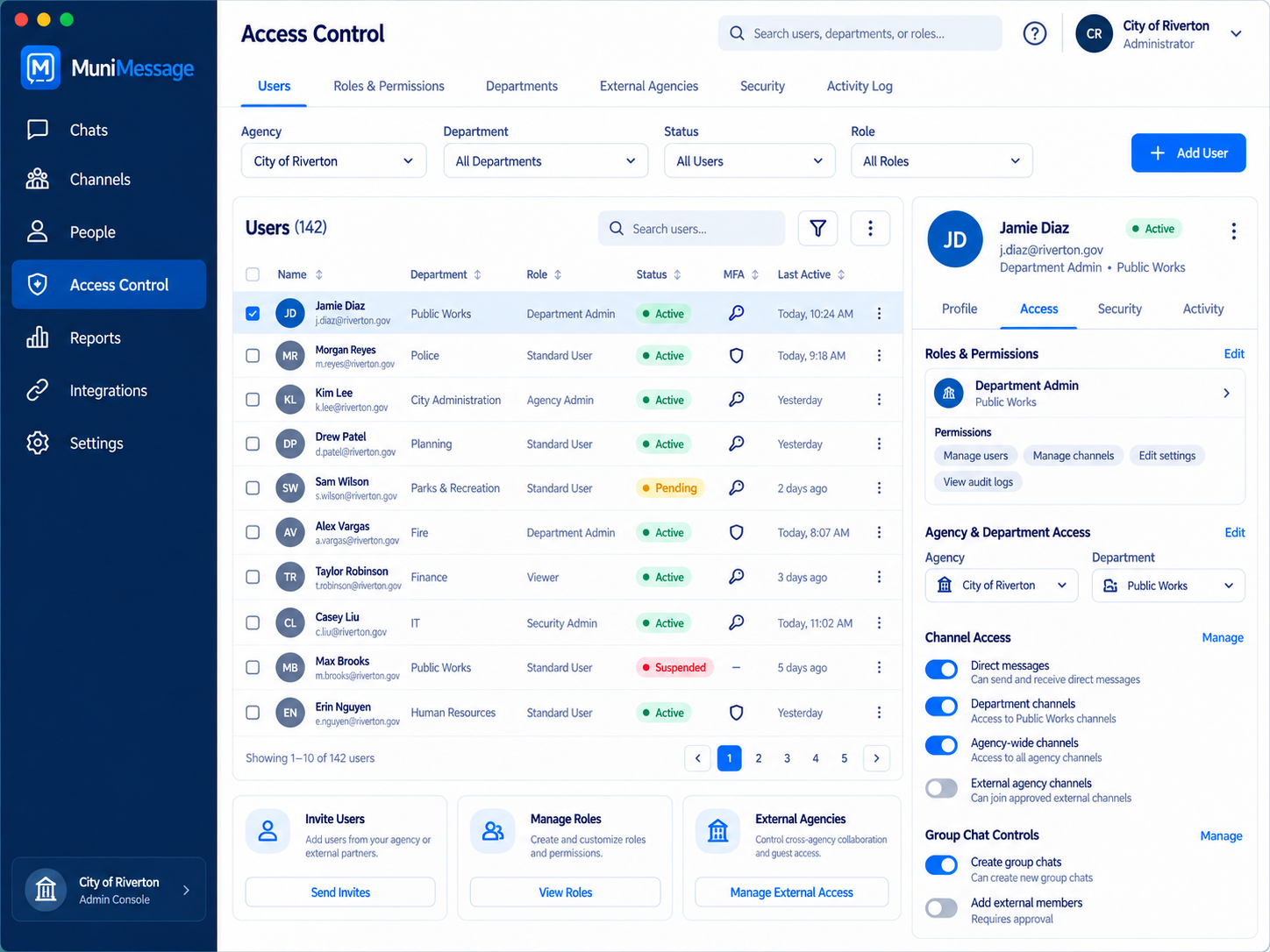
Joining the organization does not mean unrestricted access.

Identity, role, department, and partner rules continue to shape what each person can do.

Department scope

Users can be limited to communication and administrative rights appropriate to their department or operating unit.

Agency-wide roles

Selected users can communicate or administer across the broader organization when their responsibilities require it.

Role-based administration

User management, organization settings, records functions, and audit access can be separated instead of giving every administrator the same privileges.

External agency access

Approved users can communicate with specific partner organizations without opening the entire internal environment.

Channels vs. groups

Channels provide persistent organization-managed spaces; group conversations remain ad-hoc messaging among selected participants.

Suspend and revoke

Access can be changed, suspended, or revoked as people change roles, leave the organization, or no longer meet access requirements.

Start simple. Keep control.

Verify the government organization first, then choose the enrollment policy that fits the deployment.

Start Free .gov Trial